
Your engineering organization is running an experiment. Or many experiments, in parallel. It didn't design them, it doesn't know it's the subject, and the results won't arrive on any schedule it can read — some in months, some in years, most impossible to trace back to the choice that caused them. By then the people who should have been accountable will have moved on, moved up, or moved out.
This isn't a warning about the AI itself failing. It's a description of what "going fast" now means — not everywhere, but exactly where it's most expensive to be wrong.
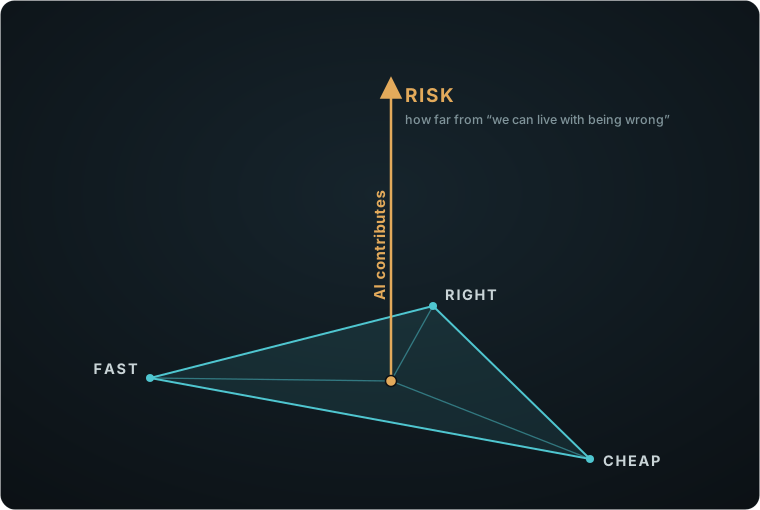
Every engineering leader knows the old tradeoff, even if they've never drawn it: fast, right, cheap — pick two. It's a flat plane of compromises, and the job has always been choosing your spot on it with your eyes open.
Risk was never a corner of that triangle. It was the axis coming out of it — how far any given spot sits from "we can live with being wrong." And what kept that axis low was never the speed of feedback. The verification loop was never fast: quarterly returns, renewals, churn all run on business-cycle time, slow as they've always been. What made slow verification tolerable was that the terrain was mapped. Most decisions reduced to a handful of genuinely novel variables; everything else pointed to well-understood mechanisms with known behavior. A wrong guess landed on well-trodden ground, so its blast radius stayed small — bounded by precedent, not by how quickly you found out. You didn't need fast verification when the map was good.
What AI changed is the change rate. It generates novel terrain faster than an always-slow verification loop can map it. More and more decisions now fall in arenas where few or none have walked before, so precedent can't bound the blast radius anymore. And the slow loop — which only ever had to confirm the occasional novel variable — can't keep pace with a world being rewritten faster than it can verify. You're still trading fast against cheap. You just can't see whether you got it right anymore, and every position on the plane has drifted up the risk axis at once — not because anyone chose more risk, but because the ground that used to absorb a wrong call slid out from under every one of them.
There's a reason this shift is so easy to miss, and it lives in how we picture the tool. We model AI as a kind of tireless human — a very fast colleague who doesn't need sleep or coffee breaks. It's understandable shorthand, and it's wrong in a way that matters here: a fast human covers familiar ground faster. They don't manufacture new terrain. So the tireless-human picture quietly tells us it's the same one we already know, just crossed at speed — which is exactly the assumption that keeps us from noticing the map no longer fits. (The Substrate and the Interface covers this at length; the short version is all we need here.)
Strip the triangle away and the pattern underneath is simpler. A decision is safe when you can hedge it at least one of three ways: bound it ahead of time, because precedent tells you roughly how wrong you can get; close it fast, because you'll know soon enough whether it worked; or reverse it cheaply if it didn't. Most decisions hand you at least one of those. The dangerous kind hands you none — no precedent to bound it, no quick signal to catch it, no cheap way back. Unhedgeable. That category isn't new; the cloud migration and the reorg lived there too. What's new is the traffic. AI manufactures novelty on one side and removes the human pause that used to force a check on the other — the hours or weeks a person spent doing the work were also time spent noticing it was going wrong — and decisions that used to arrive hedged now arrive naked.
Verification is improving too — better evals, better observability, and for plenty of tasks checking an answer really is easier than producing one. But those gains land on the decisions that were already checkable; they don't reach the unhedgeable ones. The distance between what you can ship and what you can confirm has stretched far enough that economists have started naming it — the 'measurability gap'.
A verification gap — no quick signal to catch a wrong call — is survivable if you've decided, in advance, who holds the risk while it's open. Many organizations have decided no such thing. As long as decisions landed on mapped terrain, they didn't have to — precedent did the work that a decision-rights map would have done, quietly bounding how wrong anyone could be. Authority, accountability, and decision-rights could stay informal and undocumented because the terrain itself kept the stakes small. When you can't tell yourself whether a call was right, the only judge left is the world it lands in — the market, the customer, the system under load. Competitive fitness gets decided outside the building now, and the verdict comes back slow.
Push decisions onto unmapped ground and precedent runs out. The call still gets made — faster than ever now — but nothing bounds it, and the slow verification loop can't close in time to catch it. So accountability has nothing to attach to except proximity. Madeleine Clare Elish gave the sharp version of this a name — the 'moral crumple zone,' where blame for an automated failure collapses onto the nearest human, whoever happens to be in reach when it breaks.
The verification lag stretches that zone across time. The person in reach is no longer the operator at the moment of failure; it's whoever still owns the system when the delayed signal finally lands — not the one who made the call, set the pace, or banked the speed, but whoever's holding it when the bill comes due.
Nobody decides this. No one says we're moving the risk from the executive who mandated the timeline to the engineer maintaining the code eighteen months later. It just happens, because there was never a map saying otherwise — and there was never a map because, for a long time, the terrain was the map. AI is the load that's now finding every place that substitute was holding the weight.
If precedent can no longer bound the risk, you're left building those constraints by hand. There's real work available here, and it's worth doing — as long as no one mistakes it for a fix. And worth doing only where it earns its place: most decisions are still hedged — precedent holds, the signal's quick, or you can hit undo — and wrapping those in ceremony is its own dysfunction. The work below is for the unhedgeable minority, the decisions AI keeps nudging across the line. Aim it there. Three moves. The first: decide who's accountable, in advance. The second: rebuild the hedges you still can — a cheap way back and a fast-enough signal. The third: build the operating system that runs experiments honestly. The first and third are about who answers for the bet; the second is about staying able to make it. None stands alone; each fails in a way the others are there to catch.
The first lever is the one the org skipped: actually write down how decision-rights, accountability, and authority line up before the terrain goes unmapped. Not as bureaucracy — as a way of deciding, on purpose and in advance, who holds the risk while verification is pending. A deliberate answer to "who's accountable for this if we can't tell whether it was right for two years" beats the default answer, which is "whoever's unlucky enough to still be here."
The second buys back the two hedges you can. The cushion precedent gave you is gone for good — you can't manufacture precedent for ground no one has walked — but the other two hedges you can rebuild by hand. Start with the undo: reversibility, blast-radius containment, staged exposure shrink the cost of a bad call when you've given up the ability to catch it early — and they're what keep a wrong bet from being a fatal one. Then the signal that lets you move at all: since the real business outcome won't land in time to drive the next decision, you steer on a proxy — leading-indicator patterns, read in combination, by people who've built the intuition to know which signals tend to mean something before the outcome confirms it. That intuition is a substitute instrument, not the real one — it can be wrong, and it often will be. Which is why the two work only together: a cheap way back keeps a wrong read from compounding while the reps train the intuition until it's worth trusting. You can't restore the map, but between a cheap way back and a fast proxy ahead, you can make an unhedgeable call behave a little more like a hedged one.
The third lever closes the loop back to the opening. That experiment you're unknowingly running? The move is to start running it on purpose — build the operating system that treats experimentation as part of the gig. Most orgs dodge it until it's too late. The containment above only works if the organization will admit, out loud, that it's experimenting — and most won't, because they still run a culture where a miss is a competence failure. That culture guarantees the worst version of events: people hide their experiments, fake the certainty they don't have, and quietly disable the containment the org just paid to build. The work is to make experimentation standard practice rather than embarrassment — and then, the part that separates it from a research lab, hold it to business outcomes anyway, so "we're experimenting" never decays into a license to stop delivering. An org that can run cheap experiments at volume, out in the open, and still ship is the only kind that compounds where the map runs out.
Here's where the three interlock. Lever two's fast signal is also the trap: reward people on the early read and you've paid them to game it — Goodhart's law, the measure becoming a target. Levers one and three are what stop that — one fixes who's accountable, three holds them to the real outcome — but only if you also fix when accountability settles. The outcomes arrive late and the signals arrive early, so you run two clocks. Reward the discipline of experimentation in the near term — whether someone ran honest, cheap, contained, well-read trials — and hold the reward for being right until ground truth shows up, however many cycles that takes, though the reward you can hold that long is mostly credit, not cash.
Delaying the reward does more than close the Goodhart loophole. It re-couples accountability to the person who made the call: an incentive that settles late and travels with the decision rather than the chair lands back on whoever actually generated the risk, instead of on whoever's nearest when it lands. And it quietly favors the long game — rewards paid over multiple cycles stop subsidizing the short-term wins that hollow out a business to make a quarter look good.
The catch is just as real, and worth being concrete about instead of waving past. You usually can't defer the cash — your best people are gone in three years, and their pay is set by a market that rewards this quarter, not the one where the verdict lands. What you can defer is the credit. Record who made which unhedgeable call and judge it when the outcome arrives, so reputation and advancement — which move senior behavior more than bonus math does — attach to being right rather than to having looked right. That outlasts turnover in a way a comp scheme can't, because reputation follows people across roles and even across companies.
It doesn't outlast everything — memories fade, the business changes shape, someone always games the record — which is why this is the hardest of the three. The wall here is the labor market, not the mechanism — and it's the one wall AI might lower itself, if it thins the market the way some predict, though that's not a bet to make soon. But even a partial version pulls the incentive off the proxy, and where the fast number can't be trusted, tying what reward you can to the slow truth is less a constraint than the only honest option left.
Some organizations already run this way — not by choice. Finance, healthcare, and safety-critical shops go to the frontier like everyone else, but with the containment the rest of this treats as elective already written into their license. That's not a handicap; it's the outside-imposed version of the discipline everyone else has to choose — which makes them, of all people, the closest thing to a worked example of experiments that can't kill you.
Though "elective" has a shelf life. Where experimental blast radius starts threatening consequences at societal scale, the constraint stops being anyone's to choose — governments will impose what organizations won't. That's a later article. But it's the way the ground is tilting.
Do all of this well and you've still only managed the risk you can see the shape of. There's a class of consequence underneath that none of these levers reach: the ones whose signal is measured in years. Skill that quietly atrophies because the model did the reps. Architectural debt that compounds in silence. Judgment that never develops because nobody had to earn it. Trust that goes quietly miscalibrated — leaned on hardest right where it's weakest — until something breaks. None of this is hand-waving; the population-level evidence is already in. Endoscopists measurably lose detection skill after a stretch working alongside AI (Lancet, 2025); AI-heavy engineering teams ship less stable code (DORA); and the research on AI and skill splits exactly where you'd fear it would — lifting the floor on routine work (Brynjolfsson et al.) while eroding judgment precisely where the work is novel and hard (the 'jagged frontier' studies). What no study can do is tell you, in time, which of these is unfolding in your own shop — the loop is longer than the experiment. No leading indicator reliably catches them — by the time the indicator moves, the cause is years gone. Even delayed incentives can't fully reach them, because the fuse is longer than anyone's tenure, sometimes longer than the business stays the same business.
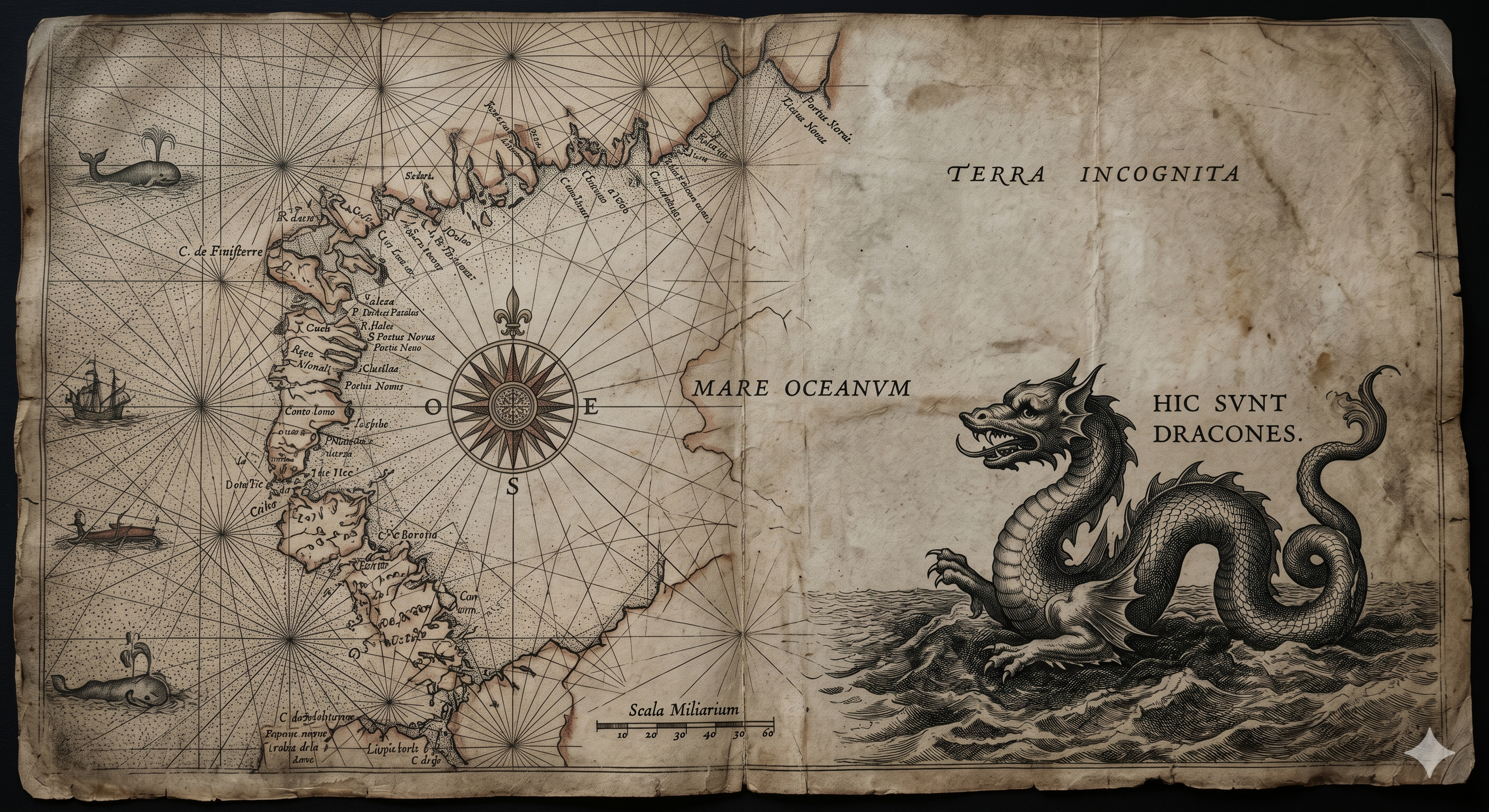
That's the residue. The honest move is to name it, not to pretend a cleverer framework dissolves it. Some of what you're deciding today, you will not be able to verify in any timeframe that lets you do anything about it. That's not a gap in your process. It's the shape of the terrain. Here there be dragons.
Which leaves exactly one way to fully opt out: don't go. Forgo the newest capabilities, stay on mapped ground, and concede the frontier to whoever was willing to walk off the map. For a rare few that's the right call; for anyone holding a competitive position in tech, it isn't a real option, and pretending otherwise is just a slower way of being left behind.
Everyone else is already in the experiment — the one nobody designed and nobody can read on schedule. The only question that's still yours to answer is whether you're running it like an organism that learns or a gambler that doesn't. The difference isn't appetite for risk — it's that an organism survives its mistakes and a gambler, eventually, doesn't. Evolution can spend its failures wholesale. A company gets one extinction and no more. So the edge isn't running more experiments, it's running more experiments that can't kill you — which is why the undo and the blast-radius limits were never optional. You can't be confident picking the winning bet from historical data anymore; the results come too late to inform the next decision — or the next seventeen. You can build the organization that runs more trials and owns them, reads the early signals better, settles its accounts against the truth instead of the proxy, and compounds what it learns faster than its rivals. In a world that's gone evolutionary, that's not an edge among many. It's the only one that isn't luck.
Sources
- Catalini et al., Some Simple Economics of AGI (2026) — the "measurability gap" between what AI can execute and what can be verified.
- Jason Wei, Asymmetry of Verification and Verifier's Law (2025) — the counter-case: for many tasks, verifying is easier than doing.
- Madeleine Clare Elish, 'Moral Crumple Zones: Cautionary Tales in Human-Robot Interaction' (2019) — blame for an automated-system failure collapsing onto the nearest human operator.
- Budzyń et al., Lancet Gastroenterology & Hepatology (2025) — endoscopists' detection rates fell after exposure to AI.
- DORA / Google Cloud, 2024 State of DevOps Report — AI adoption associated with reduced delivery stability.
- Brynjolfsson, Li & Raymond, Generative AI at Work (NBER working paper; published in the Quarterly Journal of Economics, 2025) — AI lifted novice performance most, in a scripted support setting.
- Dell'Acqua et al., Navigating the Jagged Technological Frontier, Organization Science (2025) — AI degraded performance on tasks outside its competence.
- Goodhart's law — the popular phrasing ("when a measure becomes a target, it ceases to be a good measure") is Marilyn Strathern's (1997), distilling Charles Goodhart's 1975 observation.